
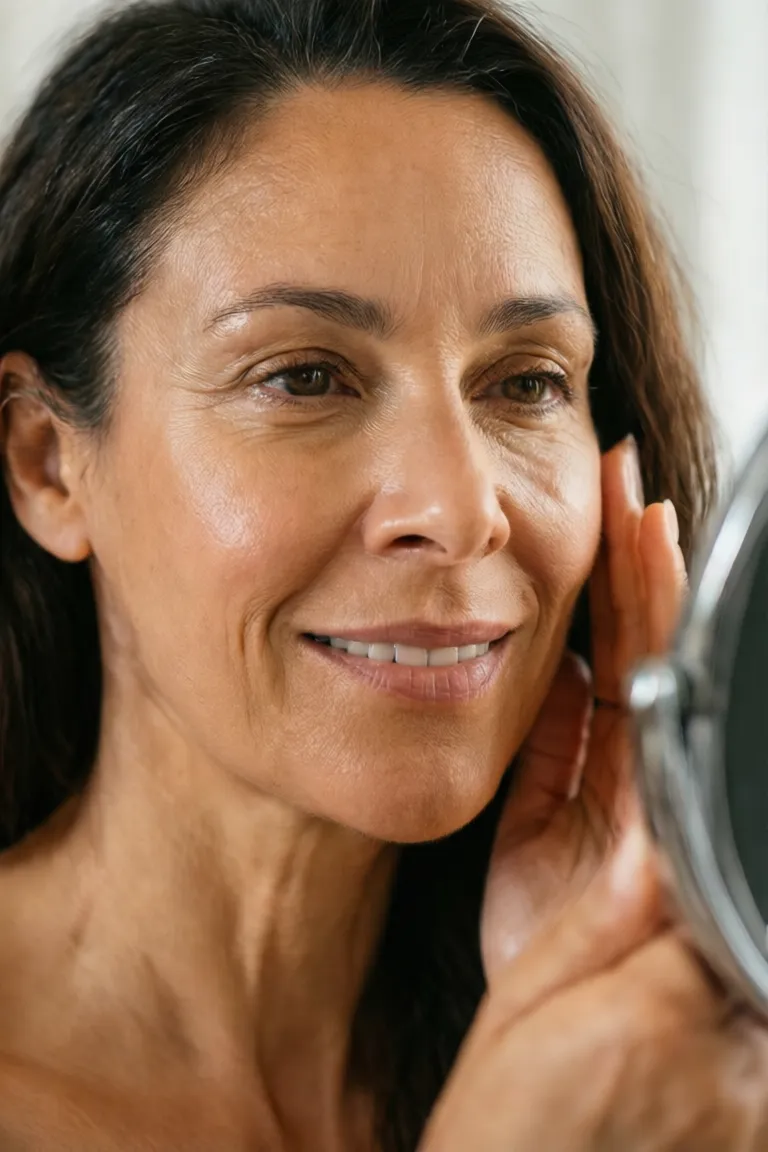
It was a Tuesday morning, under the unforgiving glare of my bathroom lights, that I saw it. I was leaning in to apply mascara when the skin on my neck and around my jawline seemed to catch the light differently. It wasn’t a wrinkle. It was a fine, crinkled texture, like tissue paper that had been crumpled and smoothed out again. It had lost its bounce. I pressed a finger to my cheek and watched it settle back slowly, not with the snap I remembered. A cold wave of something between surprise and betrayal washed over me. I did everything right. I ran three times a week, ate my greens, drank water like it was my job, and had been religiously applying SPF 50 for over a decade. I’d even kept up with a solid skincare routine. So why, at 47, was my skin looking… crepey?
For months, that moment haunted me. I’d catch my reflection in a store window and feel a pang of frustration. I had followed the so-called rules, and my skin was changing anyway. It felt profoundly unfair. This wasn’t about chasing some impossible standard of youth; it was about the foundation I thought I was building suddenly feeling unstable. I was a healthy, active woman, yet my skin was telling a different story. I became obsessed with fixing it, which launched me into a cycle of product-hopping that left my bathroom cabinet overflowing and my wallet much lighter, but my skin looking just as lackluster.
It took me nearly a year of frustration, research, and a major mindset shift to understand what was really happening. I discovered that restoring skin elasticity after 40 is less about finding a miracle cream and more about a strategic, patient combination of daily protection, barrier support, and ingredients that work with your skin’s biology—not against it. This is the journey from confusion to clarity.
The Morning I Realized My Skin Had Lost Its Bounce
That initial sighting wasn't just about vanity; it was a physical sensation. My skin didn't feel as supple. When I pinched the back of my hand, it took longer to flatten back out. What crepey skin can look and feel like after 40 is this subtle loss of resilience, a texture that can appear on the neck, décolletage, and around the eyes, even when deep wrinkles aren't present. I learned I wasn't imagining it.
Around perimenopause, estrogen levels begin to fluctuate and decline, and estrogen is a key player in stimulating collagen and elastin production. Combine that with decades of cumulative, subtle UV exposure (yes, even with sunscreen, some gets through), and the cellular machinery that keeps skin plump and springy simply slows down. It’s a natural, if frustrating, architectural shift. I thought my healthy habits were a shield, but they were more like a filter—they slowed the damage, but they couldn't stop time. The realization that skin elasticity after 40 could diminish even though I wear sunscreen was a hard pill to swallow. It meant the goalposts had moved, and my strategy needed to evolve.
Why My Expensive Firming Creams Did Not Lift My Skin
Armed with worry and a credit card, I went to war. I bought every jar that promised "lifting," "firming," and "elasticity restoration." I slathered on rich creams, applied collagen-boosting serums, and layered hydrating toners. For a few hours, my skin would look plumper, dewier—happy. But by afternoon, the crepey texture on my neck would be back. I felt like I was wasting money, asking myself, "am I wasting money on firming creams after 40?"
The hard truth I had to learn is the difference between moisture, surface plumping, and true collagen remodeling. Those luxurious creams were excellent at hydrating and temporarily plumping the very top layer of my skin with humectants. They improved dryness, which is important, but they weren't reaching the deeper dermis where collagen, elastin, and hyaluronic acid live and define skin's structure. They were watering the lawn, but not fixing the sinking foundation. Dermatologists I later read confirmed that most firming creams offer subtle, temporary improvements at best. They can't physically lift skin that's lost its underlying scaffolding. This was the core of my frustration: I was treating the symptom (a dry, crinkled surface) but completely missing the cause (a deeper structural deficit).
The Turning Point: Letting Go of the Miracle Cure Mentality
My breakthrough came not from another purchase, but from a moment of exhaustion. I was staring at a complicated 10-step routine that was starting to irritate my skin, and I thought, "This isn't working." I stepped back and started reading dermatologist interviews and scientific literature instead of product reviews. I realized I had been in a reactive panic, throwing solutions at a problem I didn't understand.
I had to accept that how to restore skin elasticity after 40 when creams are not working required a different playbook. My goal shifted from "fix this immediately" to "support my skin's health long-term." This was the mindset change that made everything else possible. I stopped looking for a hero product and started building a hero routine. I gave myself permission to think in terms of months, not weeks. This shift from consumer to caretaker was the most important step in my entire journey.
The Routine I Built After Product-Hopping Failed
I cleared my shelf and started from scratch with a gentle, evidence-based approach. My new mantra was: protect, support, and stimulate—in that order. No more stacking six different actives. No more chasing the next shiny bottle. I built what I now consider the best routine for restoring skin elasticity after 40 without irritation.
Morning: Gentle Cleansing, Antioxidant Support, Moisturizer, and Broad-Spectrum SPF My a.m. routine became simple and non-negotiable. A lukewarm water rinse or the gentlest cleanser, a vitamin C serum (a proven antioxidant that helps protect against free radicals and can support collagen), a basic moisturizer with ceramides to reinforce my skin barrier, and my holy grail: a mineral sunscreen. I learned that daily SPF is the single most effective way to prevent further loss of elasticity. No exceptions. The SPF wasn't just for beach days; it was the daily armor protecting the fragile new collagen I was trying so hard to encourage.
Evening: Barrier-Supporting Moisturizer and Gradual Retinoid Use At night, I focused on repair. After a double cleanse to remove sunscreen, I used a rich, barrier-repair moisturizer. Then, the game-changer: a retinoid. I started with an over-the-counter retinol, using it just twice a week on dry skin, sandwiched between layers of moisturizer to minimize irritation. Retinoids are one of the few topical ingredients clinically shown to encourage collagen production over time. This wasn't an overnight miracle; it was a long-term investment. I was finally addressing the "why" behind the crepiness.
What I Could Realistically Expect After 8 Weeks, 3 Months, and 6 Months
This is the part most articles gloss over, and it’s crucial for managing expectations. When you're trying to improve crepey skin after 40 despite eating healthy, you need a realistic timeline. Here’s my honest diary of change.
The First 8 Weeks: The Hydration Halo This is where hydration and barrier repair shine. My skin felt smoother, softer, and more comfortable within the first few weeks. The appearance of crepiness lessened because my skin was better hydrated—it was like spritzing a wrinkled shirt; it looks better, but the fabric itself hasn't changed. This wasn't the structural change yet, but it was a great morale booster. It proved my skin was responding to care.
The 3-Month Mark: The Subtle Shift This is often the earliest you might see subtle changes from a retinoid. For me, the texture on my cheeks began to look more refined, a little "brighter." The skin on my neck felt firmer to the touch. It wasn't a dramatic transformation, but when I compared monthly photos in consistent lighting, I could see a slight improvement in the fine, crinkled texture. The progress was slow but measurable. This is when I stopped asking "how long does it take to improve skin elasticity after 40" and started trusting the process.
The 6-Month Milestone: Patience Pays Off After six months of consistent SPF, barrier care, and retinoid use, I saw a noticeable improvement in overall firmness and elasticity. The crepey texture wasn't gone, but it was significantly softened. My skin had a resilience I hadn't felt in years. When I pressed my cheek, it bounced back with more vigor. This timeline taught me that restoring skin elasticity is a marathon, not a sprint. The collagen in your skin turns over very slowly; you're essentially waiting for a new, stronger support system to be built, brick by brick.
| Approach | Best For | Realistic Timeline for Visible Change | Key Consideration |
|---|---|---|---|
| Hydration & Barrier Focus | Those new to anti-aging or with sensitive skin; addresses dryness and comfort. | 2–8 weeks for improved texture and plumpness. | Improves the appearance of crepiness but doesn't rebuild lost collagen. |
| Topical Actives (e.g., Retinoids, Peptides) | Anyone ready for a consistent, long-term routine targeting collagen production. | 3–6 months for subtle firming and texture refinement. | Requires patience, sun protection, and managing potential irritation. |
| Lifestyle & Holistic Support | Complementing any topical routine; diet, exercise, sleep, stress management. | 3+ months for supporting overall skin health from within. | Powerful foundation, but rarely sufficient alone for significant elasticity loss. |
| In-Office Professional Treatments | Significant laxity or volume loss where topical care has plateaued. | Months for collagen remodeling; often requires a series of treatments. | Involves higher cost, downtime, and professional expertise. |
Scientific Evidence
When Skincare Was Not Enough—and When I Considered Professional Options
Even with my improved routine, I had to have an honest conversation with myself. Topical skincare has limits. It can improve texture, firmness, and hydration remarkably well, but it cannot physically lift skin that has experienced significant laxity or volume loss. Dryness or fine crepiness versus meaningful laxity and volume loss are different challenges.
For the deeper folds and more pronounced sagging that started around my jawline, I knew skincare would only do so much. I started researching in-office treatments. Procedures like radiofrequency microneedling or ultrasound therapy work by delivering energy deeper into the skin than any cream can reach, to trigger a wound-healing response and collagen remodeling from the inside out. I consulted with a board-certified dermatologist who explained the expected number of treatments (usually a series), the costs, and the fact that results appear gradually over several months as new collagen forms. It was a sobering but empowering realization: for some concerns, a professional with the right tools is the proportionate response. It wasn't a failure of my routine; it was an acknowledgment of its realistic scope.
The Unseen Pillars: What I Was Already Doing Right
In my frustration, I had completely discounted the powerful work I was already doing. My regular exercise, especially strength training, promotes healthy circulation and supports muscle tone, which provides a better underlying structure for skin. My healthy diet, rich in vitamins and proteins, gave my body the building blocks it needed for repair. My commitment to sleep and stress management (as much as any parent can!) supported my overall hormone balance.
My experience restoring skin elasticity after 40 taught me that my skincare routine wasn't working in a vacuum; it was the final, topical layer of a holistic health foundation I had already built. I stopped blaming my body for aging and started supporting it comprehensively. This mindset shift was perhaps the most nourishing "product" of all.
How I Measure Progress Beyond the Mirror
Chasing a memory of your 30-year-old skin is a recipe for disappointment. I had to find new ways to measure success. I stopped examining my skin under magnifying mirrors and started paying attention to how it felt. Was it comfortable? Did my makeup apply smoothly without settling into fine lines? Did I catch a glimpse of my reflection and think, "Hey, you look rested"?
I also took monthly photos in the same room, with the same neutral lighting. No makeup, no flattering angles. Side-by-side, the gradual improvement in texture and firmness was undeniable. This visual proof was far more reliable than my emotional daily appraisal. It shifted my focus from a flaw to be fixed to a project of nurturing and maintenance. Progress wasn't about looking 30 again; it was about my skin looking and feeling like the healthiest, most resilient version of itself at 47.
Frequently Asked Questions

Q: How long does it really take to see results when trying to restore skin elasticity after 40? A: It depends on what results you're looking for. Improved hydration and comfort can happen within weeks. Meaningful changes in firmness and texture from collagen-supporting ingredients like retinoids typically take a minimum of 3-6 months of consistent use. True collagen remodeling is a slow biological process, so patience and consistency are your most important products.
Q: Does retinol actually help restore skin elasticity, or does it just exfoliate? A: Retinol does more than just exfoliate. It works at a cellular level to speed up skin cell turnover (which improves texture) and, crucially, it signals your skin cells to produce more collagen and elastin over time. This is why it's considered a gold-standard ingredient for addressing the structural loss that leads to crepiness and laxity, not just the surface appearance.
Q: I wear sunscreen every day and eat well, so why isn’t my skincare routine restoring skin elasticity? A: First, give yourself credit—the sunscreen and diet are preventing further damage, which is huge. The gap might be in the active ingredients. A routine heavy on moisturizers but lacking in collagen-stimulating actives (like retinoids or certain peptides) may only address hydration. Also, consider if your skin barrier is healthy; if it's compromised from over-exfoliation or harsh products, it can't effectively utilize the good ingredients you're applying.
Q: Are collagen supplements worth taking for skin elasticity after 40? A: The evidence is still emerging and mixed. Some studies suggest certain collagen peptides can improve skin hydration and elasticity, while others show minimal effect. In my honest experience with collagen supplements for skin elasticity after 40, they weren't a magic bullet, but some people find them a helpful complement. If you try them, look for hydrolyzed collagen peptides from reputable sources and remember they are a supplement to, not a replacement for, a solid topical routine and sun protection.
Q: When should I consider professional treatments instead of just skincare? A: Consider a consultation with a dermatologist if you feel your topical routine has plateaued after 6-12 consistent months, or if you are dealing with significant sagging, deep folds, or volume loss that no cream can address. Treatments like radiofrequency, laser, or ultrasound can target deeper layers of skin for lifting and tightening that topical products cannot achieve. It's about matching the tool to the task.
📌 Love this guide? Save it on Pinterest!
Pin Restore Skin Elasticity After 40: My Honest Journey & What Really Works 2026 to your board so you can come back to it later.

